

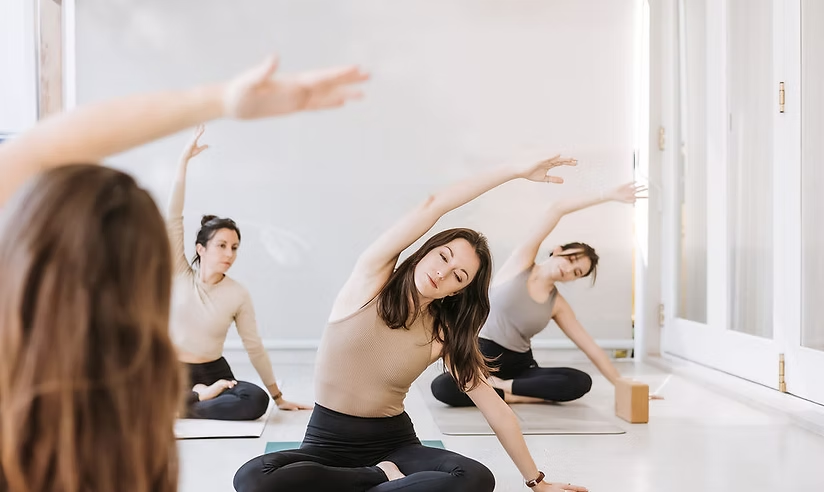
Some movement goals cannot be reduced to becoming stronger or more flexible. A practitioner may want to return to floor exercise after surgery, improve balance without aggravating knee discomfort or coordinate yoga with running and strength training. Several constraints may need to be managed at the same time.
In these situations, private yoga classes singapore sessions can provide more observation, discussion and adaptation than a general group format. Private instruction is not automatically medical treatment, and complexity does not guarantee suitability. Its value lies in organising an appropriate movement plan around clearly defined boundaries.
A Goal Becomes Complex When Demands Interact
A single posture may require shoulder range, wrist tolerance, trunk control and confidence. Difficulty in any one area changes the overall task.
Complexity also comes from scheduling. A runner seeking mobility may already have high lower-body training load, so adding repeated deep lunges could increase fatigue rather than improve recovery.
Start by Defining the Real-World Outcome
“Improve mobility” can mean many things. The practitioner may want to sit comfortably on the floor, reach overhead at work or return to a sport.
A functional outcome helps the instructor choose relevant movements. It also prevents the programme from chasing posture depth that has little connection to the person’s life.
Medical Clearance Does Not Design the Programme
A clinician may confirm that exercise is permitted or provide restrictions. That information is important but does not specify every yoga variation.
The instructor still needs to build a gradual plan within those boundaries. Communication between professionals may help when roles and consent are clear, but yoga teaching should not be presented as rehabilitation unless the provider is appropriately qualified.
Pain Requires Careful Scope
Persistent pain can involve physical, medical and psychological factors. One posture assessment cannot identify the cause.
Private instruction may help modify exercise around known guidance, but it cannot replace diagnosis. New, severe or worsening symptoms require healthcare assessment before progression.
Floor Access Is a Multi-Step Goal
Getting down to and up from a mat involves balance, leg strength, joint range and confidence. Practising only seated floor poses overlooks the transition.
A private programme can break the task into supported squats, half-kneeling, hand support and controlled rises. The route can be adapted to the practitioner rather than judged against one elegant method.
Balance Goals Need Context
Balance differs when standing still, stepping, turning or moving the head. A person may succeed in one condition and struggle in another.
Training can begin near a wall and progress through changes in base, gaze or direction. Closing the eyes or using unstable surfaces is not automatically necessary.
Hypermobility Changes the Priority
A practitioner with large passive ranges may not need more stretching. The more useful goal may be strength, position awareness and control near the available range.
Private instruction allows the teacher to avoid praising depth as the main achievement. Smaller controlled movements can be more relevant than extreme shapes.
Restricted Mobility Is Not Always a Stretching Problem
Joint structure, previous injury, nervous-system protection and muscular strength can all influence range. Forcing a “tight” area may not address the limiting factor.
The plan can compare active and supported movement, observe symptoms and select tolerable ranges. Persistent concern should be referred appropriately.
Sport Goals Require Load Coordination
Yoga can complement running, racket sports, cycling or strength training, but it still creates exercise demand. A difficult session placed before competition or heavy lifting may affect performance.
Private scheduling can emphasise recovery, mobility or strength according to the training week. The yoga programme should fit the wider plan rather than compete with it.
Breathing Goals May Need Individual Pacing
Some people find paced breathing calming, while others experience air hunger or anxiety when instructed to slow excessively.
A private setting allows the teacher to use comfortable rhythms and observe the response. Formal retention or specialised techniques require appropriate context and may not suit every health condition.
Pregnancy Requires Individual Consideration
Pregnancy changes balance, fatigue and comfort over time. Previous yoga experience and medical guidance also matter.
Private instruction can adapt positions, but it should remain within the instructor’s competence. Relevant symptoms or risk factors require advice from the practitioner’s healthcare team.
Return After Surgery Needs Clear Boundaries
Healing timelines and restrictions depend on the procedure and individual. Feeling eager does not establish tissue readiness.
A clinician should provide relevant guidance. The instructor can then begin with manageable movement and avoid assuming that a standard post-surgery sequence exists.
Neurological and Vestibular Concerns Affect Transitions
Rapid head movement, position changes or visual demands can provoke symptoms in some people. Group pacing may not leave time for a gradual transition.
Private sessions can slow the route and use stable visual reference points. However, unexplained dizziness or neurological symptoms require medical evaluation.
Multiple Goals Need Prioritisation
Trying to improve balance, flexibility, strength, breathing and endurance equally in every session can create an unfocused programme.
The practitioner and instructor can identify one primary and one supporting goal for a training block. Other qualities can be maintained without dominating the session.
Constraints Should Be Written Clearly
Relevant medical guidance, uncomfortable ranges and prohibited movements should be recorded in a concise plan. This reduces reliance on memory.
The record should be protected and limited to necessary information. Private instruction does not justify collecting every detail of a person’s health history.
Progression Should Be Criteria-Based
Moving to a harder variation because several weeks have passed may be inappropriate. Progress is better linked to control, symptom response and recovery.
Criteria might include steady breathing, reliable balance or completion without increased symptoms later. The exact standard depends on the goal.
Setbacks Need a Planned Response
Complex goals rarely progress in a straight line. Travel, illness or a flare in symptoms can temporarily reduce capacity.
A useful programme includes easier options rather than forcing a choice between full intensity and stopping all movement. Significant changes still require professional review.
Home Practice Should Remain Simple
Complexity in the goal does not require a complicated homework sequence. A small number of clearly understood exercises is easier to perform consistently.
Video reminders may help when privacy and technique limits are addressed. The practitioner should know which symptoms mean the exercise should stop.
Private Instruction Has Limits
One-to-one attention cannot make every yoga posture suitable. It does not remove structural limitations, medical risk or the need for recovery.
A responsible instructor is willing to exclude movements, refer concerns and state when the goal falls outside yoga teaching.
Choose Individualisation for the Right Reason
At Yoga Edition, practitioners can use a one-to-one session to discuss movement goals, previous experience and relevant professional guidance. This creates room for a plan based on actual needs rather than assumptions from a class label.
Private yoga is particularly useful when several movement demands must be coordinated. Its role is not to promise a perfect posture or replace healthcare. It provides a structured setting in which goals can be prioritised, options tested and progress adjusted according to response.
Frequently Asked Questions
What counts as a complex movement goal?
A goal is complex when several demands, restrictions, symptoms or other training commitments interact and require coordinated planning.
Can private yoga treat chronic pain?
Yoga may support movement, but private instruction does not diagnose or treat chronic pain unless the provider has separate appropriate clinical qualifications.
Should I bring medical reports to the instructor?
Share only relevant guidance and restrictions you are comfortable providing. Detailed medical records may be unnecessary.
Is private yoga suitable after surgery?
It may be considered after appropriate medical guidance, with restrictions and progression matched to the procedure and individual.
Can private classes help hypermobile practitioners?
They can emphasise strength, awareness and range control instead of automatically pursuing more flexibility.
How many goals should a programme address?
Prioritising one main goal and a supporting goal usually creates clearer sessions while other qualities are maintained.